TSEP OverLord™ — MacroClimate Control
Heat what you
can see.
Not the air.
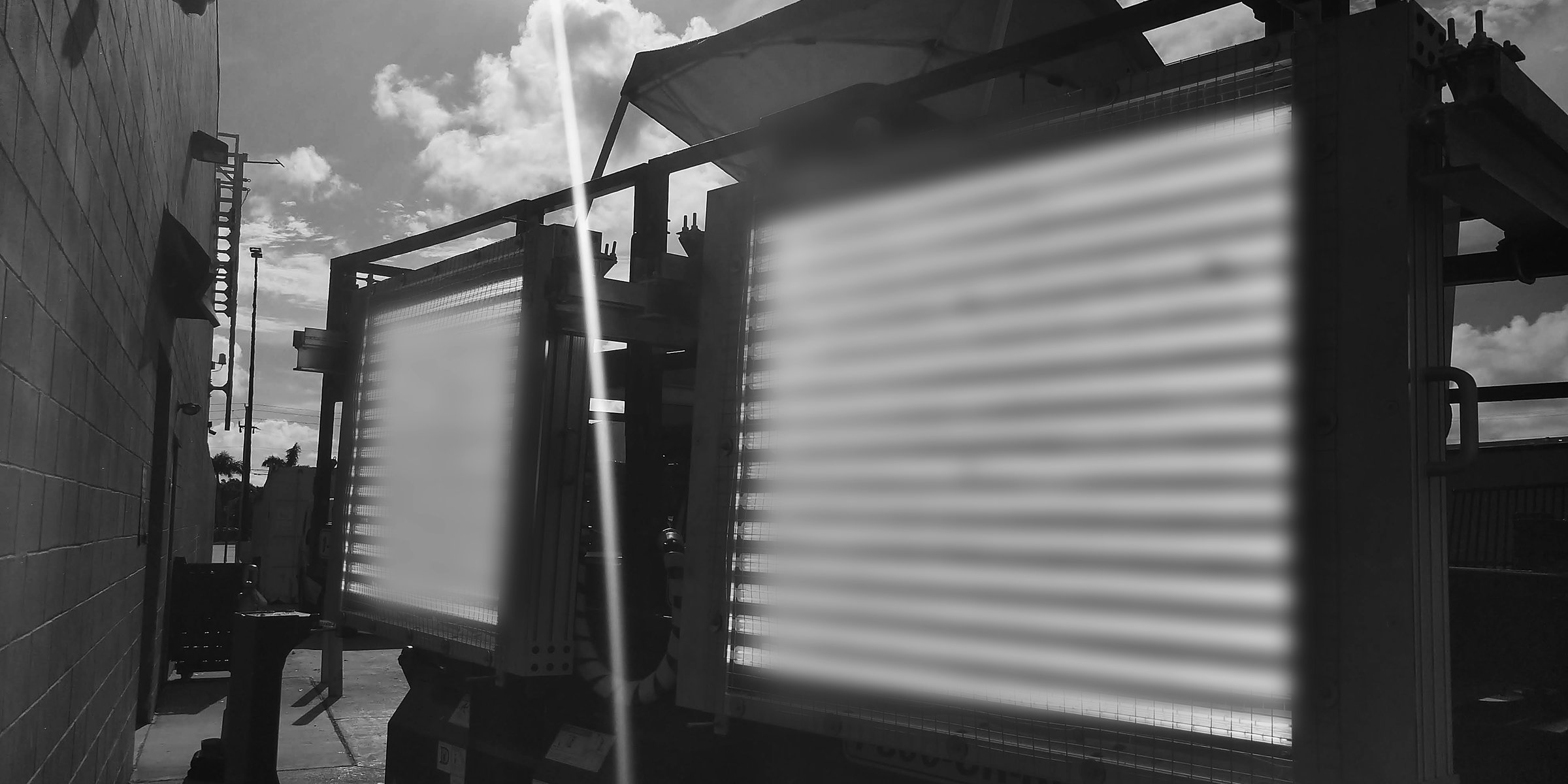
A portable radiant platform that throws massive heat on demand — roughly 90,000 watts, ~308,000 BTU in its current configuration — conditioning the surfaces it faces instead of the space around them. The same patented engine that dehydrates coatings without chemicals or water, at the macro scale: 3D-printed concrete and cold-weather construction heating.
One Engine — Two Proven Scales
The same engine,
at two scales.
Proven at scale
~1M ft² coating dehydrationIndependently assessed for removal, substrate integrity, air safety, and waste.
Read the evidence brief → TSEP OverLord™ — MacroClimateThis platform
Proven · field & physicsThe same 90,000-watt engine at the macro scale: cold-weather heating and 3D-printed concrete. No enclosure, because it doesn't heat the air.
The Platform — The Engine Behind Both
Physics,
not enclosure.
Each deployed system runs at 90,000 watts — roughly 308,000 BTU of radiant output, on demand, fully portable. It doesn't warm a room; it radiates energy straight onto the surfaces it faces — the wall, the slab, the material, the crew. The watts-per-inch output range is protected by patent on cementitious substrates, so the platform is built larger or smaller to whatever a project needs.
No tenting, no scaffolding, no visqueen, no temporary heat houses — and none of the cost or schedule they add.
Radiant projection heats the work directly; you're not paying to heat air that leaks or blows away.
A construction-grade radiant platform with a real field history, built to move around a site.
Built to whatever configuration a project needs — the output range is the patented part.
Application 01 — Cold-Weather Construction Heating
Winter stops the work.
It doesn't have to.
Below temperature, concrete won't cure and masonry won't set — so crews wrap the work in scaffolding and visqueen and run rented heaters around the clock, burning fuel to warm air that leaks straight back out.
A portable radiant unit aimed at the wall, slab, or material warms the mass directly — no enclosure, no heated-air loss. Macro heat for large, fast-paced jobsites where tenting is impractical and ceiling height turns containment into a fight.
Application 02 — 3D Concrete Printing
Interlayer bond & cure.
When a deposited layer cools before the next pass arrives, the two beads bond weakly at the interface. Those cold joints become the planes of weakness that govern how a printed element performs — and they're invisible once the wall is up.
Below certain temperatures, cementitious printing stalls — cure slows, early strength suffers, and the build window closes. Season, not capability, ends up capping how much can be printed and when.
How it works — no magic, just radiant energy
Designed to dehydrate coatings on cementitious substrates, and it has done exactly that across roughly a million square feet. Same hardware, aimed at a new surface.
We set up well back from the print and radiate energy at it; whatever the system sees, it warms.
3DCP runs fast, with a large robotic arm moving overhead — there's no easy way to throw a roof over it, and standing up cold-weather protection can take longer than the print itself.
A warmer surface is a drier surface. Radiating dry heat at the print gives the next pass a warmer, drier surface to land on. We don't claim more than that.
Straight Talk — Proven vs. Being Validated
Stated separately,
on purpose.
Proven now
- The radiant platform itself — roughly one million ft² of field operation.
- A massive, portable BTU output that radiates heat at a surface from across the work zone.
- Field-proven on cementitious substrates — no contact, no enclosure.
Being documented with partners
- The print benefit of a warmer, drier surface, measured on real jobs.
- How far the print window stretches in cold or high-humidity conditions.
- Working alongside active 3DCP systems and crews in the field.